
All countries

Austria
DLR adoption: 0/100
Belgium
DLR adoption: 72.86/100
Croatia
DLR adoption: 0/100
Czech Republic
DLR adoption: 40.22/100
France
DLR adoption: 0/100
Germany - 50Hertz
DLR adoption: 14/100
Germany - Amprion
DLR adoption: 43.43/100
Germany - TenneT
DLR adoption: 54.48/100
Germany - TransnetBW
DLR adoption: 36.19/100
Hungary
DLR adoption: 0/100
Luxembourg
DLR adoption: 0/100
Netherlands
DLR adoption: 34.27/100
Poland
DLR adoption: 63.83/100
Romania
DLR adoption: 0/100
Slovakia
DLR adoption: 13.38/100
Slovenia
DLR adoption: 0/100

Data sources and methodology

Data sources

You can find below the data sources used to calculate the CurrENT Grid Compass KPIs:

Data sources and methodology

The Transmission Efficiency indicator is calculated by combining the weighted results of seven different sub-indicators. These sub-indicators assess:

  • Whether Dynamic Line Rating have been applied by Transmission System Operators (TSOs) across Europe;
  • The extent to which this technology has been deployed;
  • The efficiency gains this technology has been delivered to the system;
  • The overall adoption rate of these technologies.

By analyzing these elements, the Dynamic Line Rating indicator gives users an overview of how extensively DLRs have been implemented in different European countries and how much they contribute to improving grid efficiency. You can hover on the map to discover each sub-indicator and the related score.

  • Sub-KPI 1A: DLR deployment on lines and interconnectors. The 1st sub-indicator measures whether the TSO has started using Dynamic Line Rating (DLR) technology on its network. DLR allows power lines to carry more electricity when conditions permit, improving efficiency.
    • Has the TSO equipped any lines with DLR?
      • Yes: 5 points
      • No: 0 points
    • Has the TSO equipped any interconnectors (cross-border lines) with DLR?
      • Yes: 5 points
      • No: 0 points
  • Sub-KPI 1B: Share of lines equipped with DLR. The 2nd sub-indicator measures how much of the TSO’s total network already benefits from DLR technology.
    This sub-indicator calculates the percentage of all lines operated by the TSO that are equipped with DLR.
  • Sub-KPI 1C: Length of DLR-Equipped Lines. The 3rd sub-indicator measures the total physical length (in kilometres) of DLR-equipped lines, compared to the total length of all lines in the TSO’s network. This helps show how extensively DLR has been rolled out in each TSO’s grid.
  • Sub-KPI 1D: New DLR Installations Since 2021. The 4th indicator measures how much new DLR has been installed since 2021.
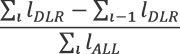
    The formula compares the total length of DLR-equipped lines in 2024 with the length in 2021, divided by the total line length.
    Formula:
    Where:
    lDLR= total length of DLR-equipped lines
    lALL= total length of all lines

  • Sub- KPI 1E1: Average ampacity gains per line (2024 vs 2021). The 5th sub-indicator measures how much the average electricity-carrying capacity (“ampacity”) of lines has increased thanks to DLR, comparing 2024 to 2021.
    Ampacity is the maximum current a line can safely carry. DLR allows lines to carry more power when conditions are favorable.
    Parameters used:
    • Amax – Maximum ampacity per line (maximum DLR vs. standard rating)
    • Amin – Minimum ampacity per line (fixed at 1, meaning no gain beyond normal ratings)
    • Afix21 – Fixed ampacity for 2021 (a fallback value if 2024 standard ratings are missing)
    • Arated – Rated ampacity in 2024 (standard rating for 2024)
    • Gmin – Minimum ampacity gain (set to 1)
    • Gavg – Average ampacity gain (the system-wide average of AavgArated\frac{Aavg}{Arated}AratedAavg for each line)
  • Sub- KPI 1E2: Average ampacity gains per interconnector (2024 vs 2021). The 6th sub-indicator measures the same type of ampacity gain, but focused only on interconnectors — the cross-border lines that link grids between countries.
    • This uses similar parameters to the previous sub-indicator but applies fewer TSO-specific constraints.
    • Maximum gains (Gmax) are calculated using combinations of different factors.
  • Sub-KPI 1F: Overall Average Ampacity Gains (2024 vs 2021). The 7th sub-indicator measures the overall average improvement in ampacity across all lines and interconnectors, comparing 2024 to 2021.
    This provides a high-level summary of grid-wide improvements in transmission capacity due to DLR.Parameters:
    • Amax1 – Average maximum ampacity for lines, weighted by total DLR line length
    • Amax2 – Average maximum ampacity for interconnectors, weighted by total DLR interconnector length

    Formula: Amax1 + Amax2 for 2024 / Amax1 + Amax2 for 2021 per TSO

    This final indicator gives a clear picture of how much more electricity the grid can carry in 2024 compared to 2021, thanks to the adoption of DLR technologies.

The below table outlines the value range for each sub-indicator, the maximum score that can get assigned for each sub-indicator and the formula for weighting the score.

Sub-KPI Value range Max points Calculation in the scoreboard
1A 0, 5, 10 20 Sub-KPI value *2
1B 0.00 to 1.00 10 Sub-KPI*max points
1C 0.00 to 1.00 20 Sub-KPI*max points
1D 0.00 to 1.00 5 Sub-KPI*10, max 5
1E1 >=0 15 If 0, then 0, else (Sub-KPI-1)*100, max 15
1E2 >=0 15 If 0, then 0, else (Sub-KPI-1)*100, max 15
1F >=0 15 If 0, then 0, else (Sub-KPI-1)*100, max 15

Questions? Comments?

Fill out the form below and we’ll get back to you.

About this map

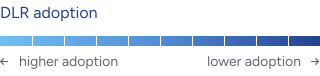
Using data from multiple public sources (including ACER and ENTSO-E), CurrENT has presented the results in an interactive format. This map is a visualization of the DLR Adoption score of the electrical grid on a scope from 0 to 100, based on how widely and effectively Transmission System Operators deploy Dynamic Line Rating (DLR). Each region is color-coded by performance, reflecting the share of lines and kilometers equipped with DLR, recent expansions since 2021, and the resulting ampacity gains. A higher score is reflected by a light blue color and a lower score is reflected by a dark blue color.

Europe’s energy transition will be driven by a large increase in electricity demand and renewable energy integration to the system. This transition will require TSOs to optimize the use of existing grids to avoid congestion and instability, especially considering the cost and long timelines for grid expansion. Dynamic Line Rating (DLR) is a technology used to monitor the real-time capacity of overhead power transmission lines using sensors. It is a proven tool to improve grid efficiency. The Transmission System Operators will face challenges in the future and Dynamic Line Rating will be key to optimizing and efficiently using existing grids without waiting for new infrastructure. 

CurrENT’s study with Compass Lexecon, “Prospects for Innovative Grid Technologies” shows that Innovative Grid Technologies can increase the efficiency of transmission grids. In this regard, Dynamic Line Rating can enable higher renewables integration by enabling TSOs to optimize line utilisation.

Indeed, DLRs can increase the capacity of the lines by an average of 10% to 45%. It will enable TSOs to identify the real capacity of the grid at a given time and dynamically adjust operational line limits while ensuring network security and reliability.

DLR, when combined with other complimentary Innovative Grid Technologies such as Inertia Management Systems, Advanced Conductors and Superconductors effectively create a multiplier effect for efficiency and speed of grid enhancement. The widescale development of Innovative Grid Technologies like DLRs is essential to ensure that Europe is able to maximize the use of the energy it generates, reducing the end cost for consumers, and facilitating the mass uptake of renewables.

Table : Overview of Dynamic Line Rating adoption score and data availability.

Country TSO Performance Comment
Austria APG Low
Belgium Elia High
Bulgaria ESO EAD - Unavailable data
Croatia HOPS Low
Czech Republic ČEPS Medium
Denmark Energinet - Unavailable data
Estonia Elering AS - Unavailable data
Finland Fingrid - Unavailable data
France RTE Low
Germany 50Hertz Transmission Low
Germany Amprion Medium
Germany Tennet GMBH High
Germany TransnetBW Low
Greece IPTO/ADMIE - Unavailable data
Hungary MAVIR Low
Italy Terna S.p.A - Unavailable data
Latvia AST - Unavailable data
Lithuania Litgrid AB - Unavailable data
Luxembourg Creos Low
Netherlands TenneT Low
Norway Statnett - Unavailable data
Poland PSE High
Portugal REN - Unavailable data
Romania Transelectrica Low
Slovakia SEPS Low
Slovenia ELES Low
Spain Red Electrica - Unavailable data
Sweden Svenska kraftnät - Unavailable data
Switzerland Swissgrid - Unavailable data

Legend :

  • On a range between 0/100 and 40/100 : Low performance
  • On a range between 20/100 and 60/100 : Medium performance
  • On a range between 60/100 and 100/100: High performance
  • The – represents countries where no public data was available