

CurrENT Grid Compass
Line losses
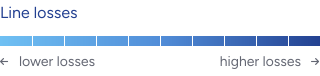
This map is a visualisation of the total power system losses at both transmission and distribution electrical grids, expressed as a percentage of electricity volume injected into a country – this value includes electricity imports. Losses include both technical and non-technical losses. A lower percentage indicates a better score with less system losses (light blue colouring).
Methodology and calculation results
Percentage losses are taken from CEER’s 3rd report on Power Losses, where the results are obtained from CEER Member countries. This report uses the same methodology as the 2nd CEER report on power losses, which states that “the majority of respondents determine losses in their countries by subtracting electricity withdrawals (by final customers and other networks) from electricity injections (from generation and other networks)”. It further states that “total injections in any given country consist of injections in transmission in addition to those by generation connected to distribution. This approach ensures that no energy was counted twice and that the calculated percentages portray the accurate values in each country.”
However, different NRAs and Member countries have different ways of measuring losses. For more details on these methodologies, see the CEER report here.
How are countries categorised in this map?
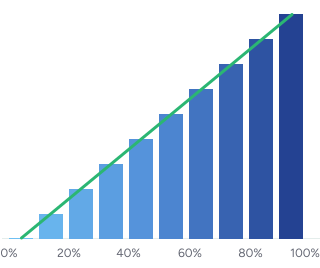
The countries are divided into 10 different groups in order to provide a clearer distinction between countries on the scale shown. This scale was devised internally by CurrENT Europe. The country groups are as follows:
- 0% – 10%
- 10% – 20%
- 20% – 30%
- 30% – 40%
- 40% – 50%
- 50% – 60%
- 60% – 70%
- 70% – 80%
- 80% – 90%
- 90% – 100%
What specific indicators does the CurrENT Grid Compass focus on?
The CurrENT Grid Compass evaluates grid performance based on the following key indicator:
- Costs of efficient, secure, and stable operations: based on the costs for redispatch costs and volumes.
- Total level of line losses across transmission and distribution systems: based on the differences between injected energy onto the system and energy taken off the grid
The KPIs are calculated by summing up the results of a subset of indicators. See CurrENT’s Grid Compass Costs of efficient, secure, and stable operations.
How are line losses calculated?
This map presents data from CEER’s 3rd report on Power Losses, where the the results are obtained from CEER Member countries. This report uses the same methodology as the 2nd CEER report on power losses, which states that “the majority of respondents determine losses in their countries by subtracting electricity withdrawals (by final customers and other networks) from electricity injections (from generation and other networks)”. It further states that “total injections in any given country consist of injections in transmission in addition to those by generation connected to distribution. This approach ensures that no energy was counted twice and that the calculated percentages portray the accurate values in each country.”
However, different NRAs and Member countries have different ways of measuring losses. For more details on these methodologies, see the CEER report here.
Questions? Comments?
Fill out the form below and we’ll get back to you.
About this map
Using data from CEER’s 3rd annual report on losses, CurrENT has presented the results in an interactive format. This map is a visualization for how much energy is lost between energy injection and the amount of energy taken off the grid and includes losses for both transmission and distribution levels. The value includes both technical and non-technial losses. Technical losses are a consequence of the laws of physics and could be reduced with more efficient equipment. Non-technical losses consists of the energy delivered but not metered or billed and often depends on socio-economic conditions of a country. When losses are low the relative grid zone is performing well, indicated by light blue colouring. Conversely, if a grid zone has high costs, indicated by dark blue colouring, this indicates poor performance.
As Europe looks to drastically increase electrification levels up to 2050, energy waste in the form or line losses is a problem that needs to be addressed. Line losses increase the end price for energy, which is ultimately passed on to consumers. Optimising and improving infrastructure to reduce losses will be vital to achieving the commitments laid out in the Affordable Energy Action Plan. When evaluating technologies to improve grid efficiency in the short-term, such as using advanced conductors, or expanding the grid to accommodate for increasing amounts of RES and electrification, reducing line losses should be a key criterion for investments in the types of technology used.
As shown in CurrENT’s study with Compass Lexecon, ‘Prospects for innovative power grid technologies’, innovative grid technologies, such as advanced conductors, capacitive transfer cables, high temperature superconductors, and modular power flow controllers, can massively reduce line losses. Reconductoring existing lines with advanced conductors offers quick and cost-effective solution to reduce line losses by up to 30%. When further building out grid infrastructure, the deployment of high temperature super conductors can reduce losses of conventional long distance transmission systems by up to 90%.
The widescale deployment of innovative grid technologies, both in the near term and the long term, is essential to ensure that Europe is able to maximise the use of the energy it generates, reducing the end cost for consumers, and facilitating the mass uptake of renewables
For further details on how this map has been calculated, please consult the Methodology section.
Contact us
If you have any questions or comments then please contact us. We’re happy to help.
